Reflections on David Conn’s Football Memoir
Richer Than God
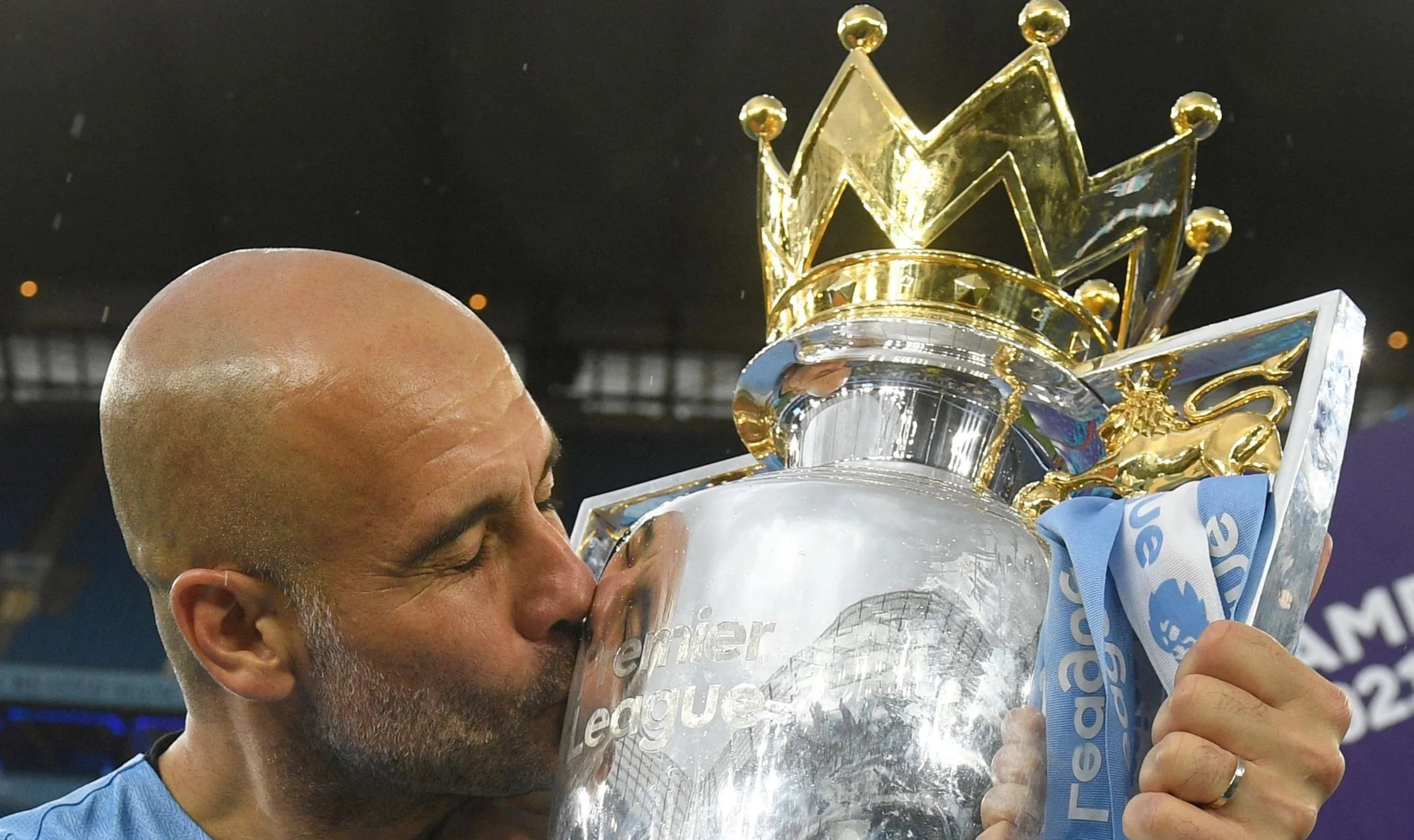
Image Source - Pep Guardiola, celebrating Manchester City’s 4th Premier League title in 5 seasons
Author:
Pages:
Year :
David Conn
420
2012
Tags:
sports, capitalism
The older I get, the more sensitive I become to the inertia of life. Habits and expectations set in earlier years work in subtle ways to direct my attention, tuning me into certain frequencies while numbing me to others. This isn't inherently a problem: we all need patterns to live by. But it's a reality that can leave me in a kind of comfort zone, unaware, or unwilling, to change course when a re-evaluation is overdue. As I’ll explore below, Richer Than God tapped into that spirit of reflection, providing a rich, thoughtful, accounting of what shifting inertia can look like.
Football, soccer, and tennis are no doubt my “Big Three”, but over the years I’ve dabbled in everything from auto-racing, golf, the NHL and NBA, and major events like the Olympics. I love sports across a few dimensions; firstly, there’s simply the joy of watching organized chaos, of witnessing human beings accomplish hard-to-believe physical feats; there’s the community aspect, the idea that I can share an anecdote or an experience with someone of a different culture and that we can appreciate that same moment; and especially for myself, I greatly enjoy the tactical element of modern sports, and the intense focus and preparation that goes into the moment of execution.
I wax lyrical, but all is not well. Alongside the forces that garnered and maintained my interest in sports have also been growing themes that have me questioning the relationship I want to have with the “Sports Industrial Complex” as I look ahead - the time watching sports takes away from an increasingly precious schedule focused on family and more enriching experiences, the increasingly questionable sources of of money that go into funding these endeavors, and the widening gap between the fans who love sports and the people who administer these leagues.
Why “Sports Industrial Complex”?
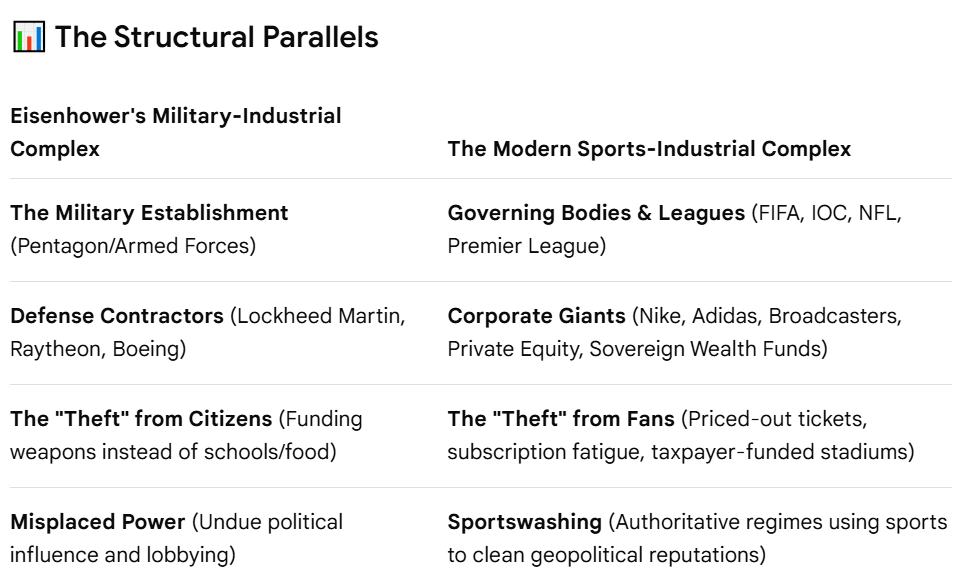
In his 1961 Farewell Address, President Dwight D. Eisenhower famously warned that an unchecked alliance between private corporations and powerful institutions could quietly erode public interest in pursuit of profit—a cautionary tale that fits today's sports landscape perfectly.
A Sports-Industrial Complex mirrors Eisenhower’s original concept by describing how the fusion of massive corporate capital, governing bodies, and media conglomerates creates an institutional force that prioritizes profit over the foundational spirit of the game.
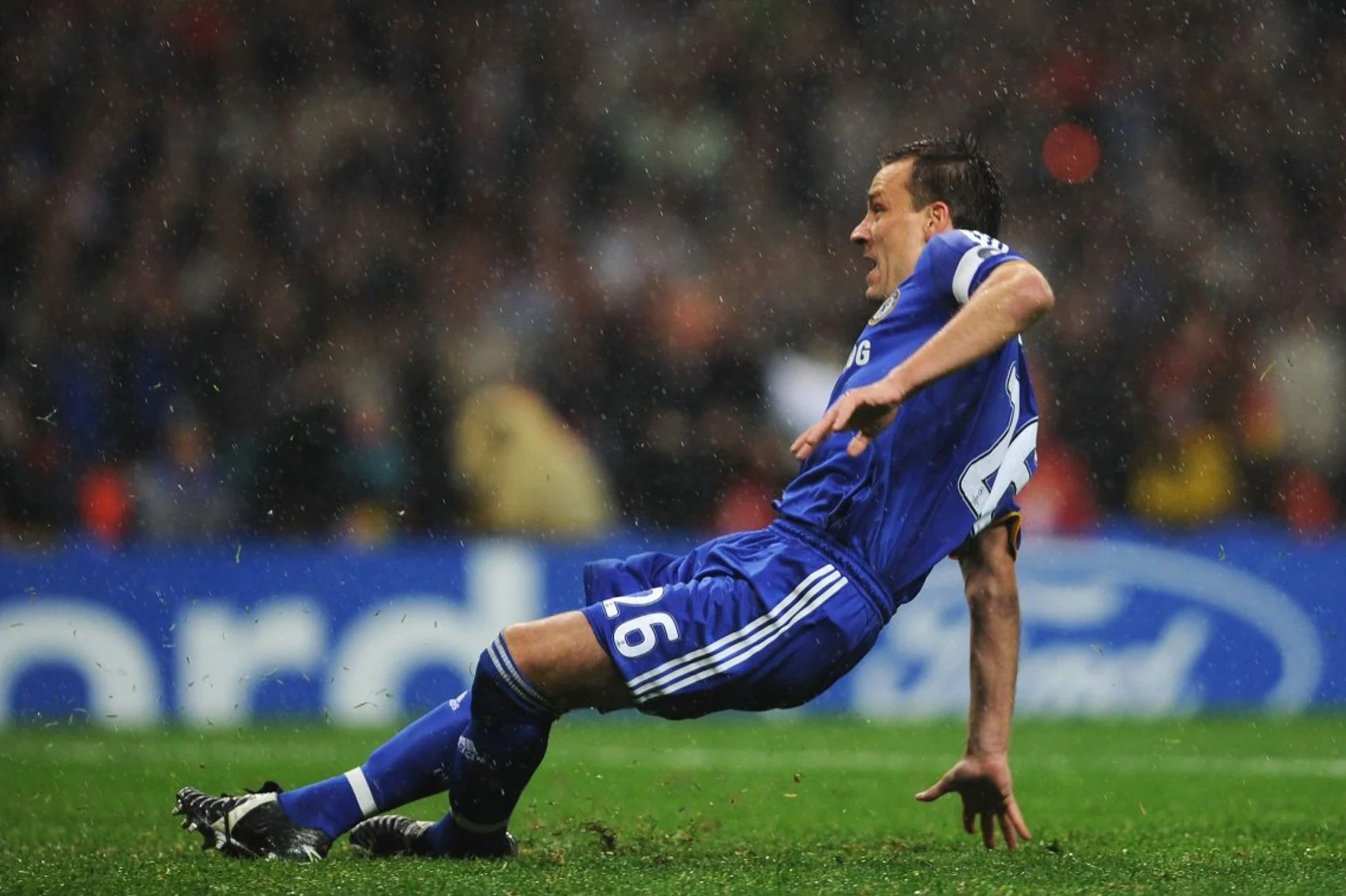
Chelsea’s John Terry misses a penalty kick against Manchester United in the 2008 UCL final; despite the loss, it was the game that put Chelsea firmly in my awareness and made me a fan
My teenage years also coincided with the arrival of NFL RedZone, arguably the most ingenious sports product ever invented: it took the NFL's already frantic pace and supercharged it, cutting commercials entirely and jumping from game to game, highlight to highlight, dominating your attention on Sunday afternoons. In some ways, it was a very consumer-friendly product, eliminating the aforementioned advertising in favor of pure football enjoyment. But naturally, accessing RedZone became a status symbol itself. I’ll never forget my Sophomore year roommate coming up with a brilliant IT-related scheme to pirate RedZone from the school’s streaming services, straight into our apartment in real time. It was just obvious that football was so popular, and that the more popular it got, the more money the NFL and media companies wanted to make.
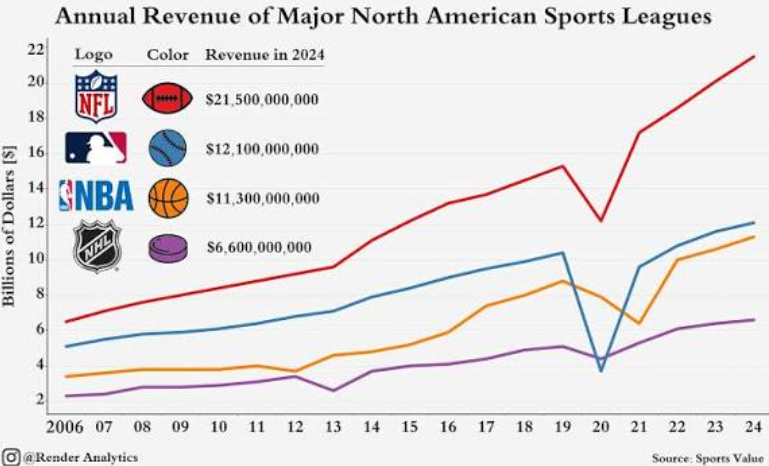
Fast forwarding to today, and the landscape has changed substantially, though the trend line has always been the same. As of last year, RedZone began featuring commercials for the first time ever, an unmistakable overture to executives to bring in more ad revenue. More striking, if surprising to no one, is how many of those ads are for sports gambling.
The signs are everywhere once you start looking. I've stopped following the A's after ownership made clear it was abandoning the team's decades-long roots in Oakland for the more lucrative pastures of Las Vegas; so much for home-town loyalty. Chelsea itself was sold, in a forced sale, to a private equity firm that has largely mismanaged the club, led by Todd Boehly, who also co-owns the LA Dodgers, a team spending Major League Baseball into oblivion. And this year, FIFA administered a World Cup on American soil that's widely considered among the most corrupt in the tournament's history.
We could point to countless more examples. The lesson of the last several decades is clear: global sports are a media product built to extract as much revenue as possible from a mass audience. Principles and legacies are speed bumps on the road to maximizing profit and attention. As NFL commissioner Roger Goodell put it just last year, the league is competing with Google and Apple for their viewers’ attention, not with other sports leagues.
My Relationship to the Sports Industrial Complex
Since I was a teenager, one of my strongest inertias has been keeping up with the ever-expanding coverage of global sports media.
It started with American football. My teenage years gave rise to a deep love for the NFL, soon followed by college football, until entire weekends could be subsumed by gridiron entertainment. These were formative years in which I joined a fantasy football league with my high school buddies (still going strong today), and had the good fortune of supporting the Indianapolis Colts and their all-time great quarterback, Peyton Manning.
Football was merely the first of what would become an extensive and life-long love of sports. I still fondly remember my dad and I hosting my high school friends for the opening game of the 2010 World Cup, two years after I had literally watched every game of the 2008 Euros competition. My dad is also an ardent tennis fan, and it wasn't long before I was following the Federer-Nadal rivalry. College saw the additions of the Wisconsin Badgers football team and a close friend who introduced me to baseball, and the peculiar mystique of the Oakland A’s.
Falling Out of Love
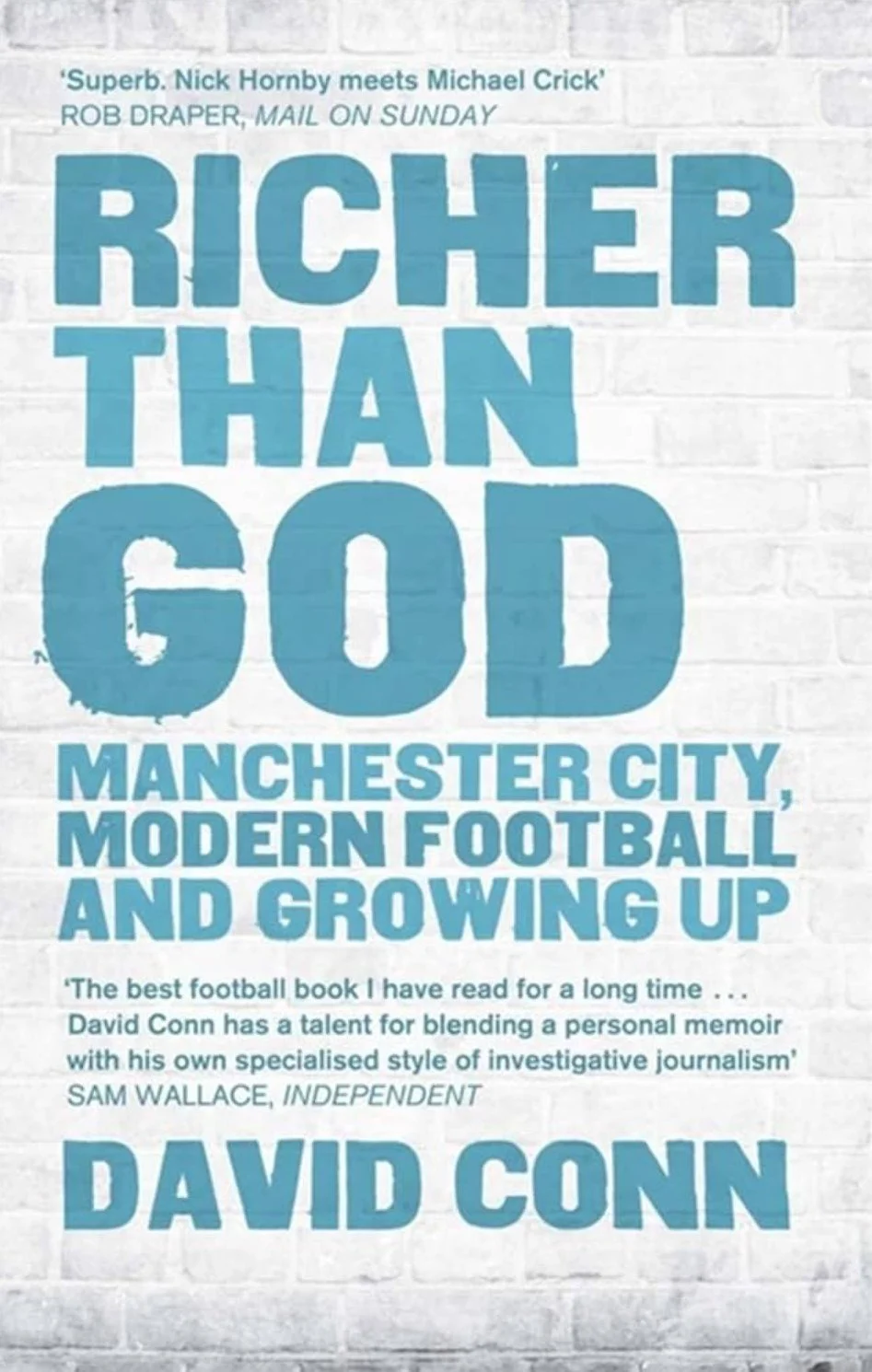
I don't remember the moment I picked up David Conn's Richer Than God (the price sticker tells me it was during one of my book buying binges at Powell's Books in Portland), but I know exactly why I bought a book like this. I've become a collector of soccer history books (The Mixer, The Club, Inverting the Pyramid, and too many still unread), but it was the premise of Conn's book immediately intrigued me, resonating with a growing discomfort I've been feeling as I watched the sports industrial complex expand. Here's the book jacket, so you get the same impression I did when I first picked it up:
Richer Than God tells the story of English football's transformation, from the battle grounds of the 1980s to today's moneyed, seated, global entertainment. Conn weaves this account into his own journey from childhood fan of Manchester City to investigating the club's extraordinary takeover by Sheikh Mansour of Abu Dhabi. This heartfelt narrative captures the passion people have for their football clubs, while questioning the values and running of what used to be called 'the people's game'.
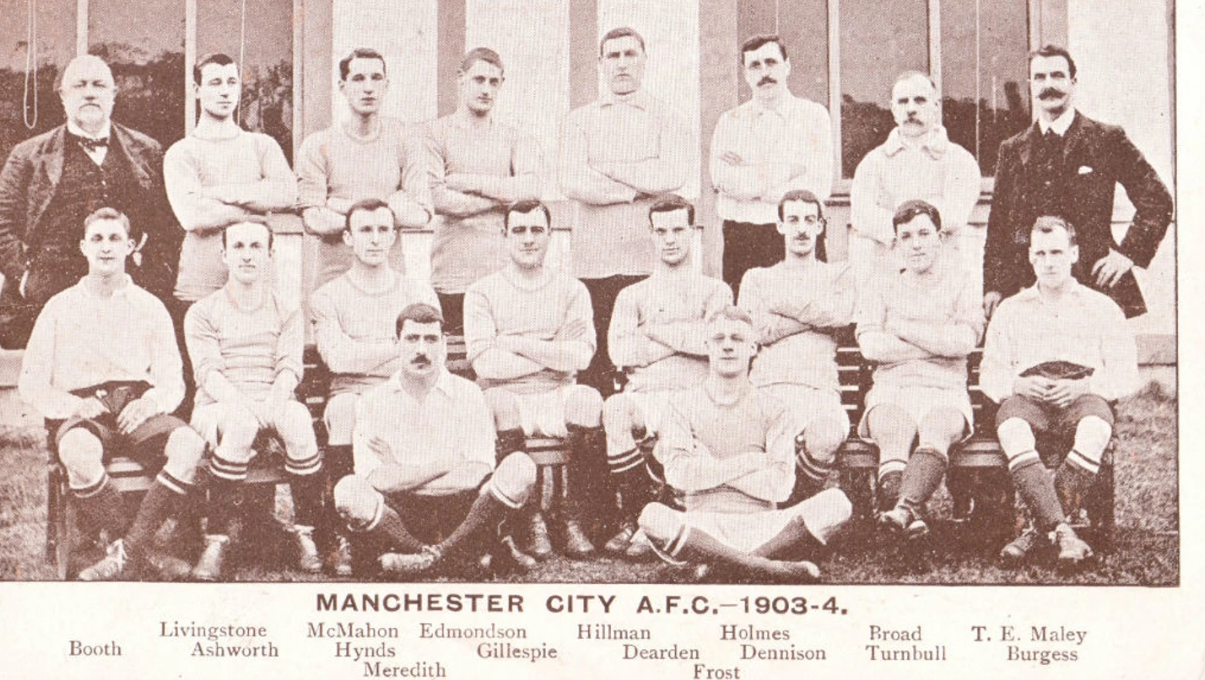
True to that description, what follows is the account of Conn - a British soccer journalist and boyhood Manchester City supporter - discovering how the inner workings of his club betrayed the founding ideals that made it worth supporting in the first place. It's a front-row seat to exactly how global sports media changed in the 1990s and 2000s, laying the groundwork for much of what we have today.
One detail I kept returning to: the book was published nearly 14 years ago, in 2012. At the time, it was an apt moment to release it, after Manchester City had just won their first Premier League title after decades of falling well short. As the reader, however, I had the benefit of context of the next decade and a half, which would see Manchester City become a goliath of English football, winning 24 trophies including 6 more league titles. Conn couldn’t have known what the future held for Manchester City, but I wonder if he’d even be surprised by how strongly his boyhood club cemented their supremacy given the piles of cash they had at their disposal.
For the uninitiated, here's a short history. Manchester City was founded in 1880 as St. Mark's (West Gorton), became Ardwick A.F.C. in 1887, and was renamed Manchester City in 1894. For most of the 20th century, the club was a modest, locally run outfit. Former player Francis Lee took over as chairman in the 1990s during a turbulent financial period. In 2007, Thai businessman and former prime minister Thaksin Shinawatra bought the club, but his tenure was brief and controversial, dogged by human rights concerns tied to his political past. The pivotal moment came in 2008, when the Abu Dhabi United Group, led by Sheikh Mansour bin Zayed Al Nahyan, purchased City and injected the wealth that would transform it into one of the richest clubs in world football. Since then, City has become the flagship club of City Football Group, a multi-club ownership network, and has used sustained investment to win multiple Premier League titles and its first UEFA Champions League, in 2023.
For the club, it's a triumphant story. For Conn, it ran in the opposite direction, souring him on his boyhood team just as it ascended into global relevance and prestige. These aren't coincidental; they're two sides of the same story.
Humble Origins
Learning How the Sausage is Made
Like Conn, my attachment to my soccer club, Chelsea, started with childhood fascination. As an American, with the Premier League's influence growing in the States, I turned on the TV one afternoon after middle school to find Manchester United and Chelsea playing in some kind of tournament (I'd later understand it was a fairly high-stakes Champions League final). My sports consciousness was limited at the time, but even then I understood that Manchester United, the "giants," were favorites, and that didn't sit right with me. So I went with the "underdogs," Chelsea, oblivious to the fact that a Russian oligarch had propped up the team into one of the most expensive squads ever assembled.
My awareness of the sports industrial complex accumulated slowly, year by year. One of the key themes was access to the games. As modern audiences are keenly aware of, watching sports can be quite expensive, and sports leagues are incentivized to gatekeep their content as much as possible.
During my Freshman year of college, I spent most Sunday’s in the Fall at the campus Buffalo Wild Wings, where I would consume copious amounts of wings and television streams of NFL games. I didn’t pay much attention to the DirectTV commercials also playing and the athletes getting paid for their endorsement, but it was an early example of how advertising revenues and sports as a product were so intertwined.
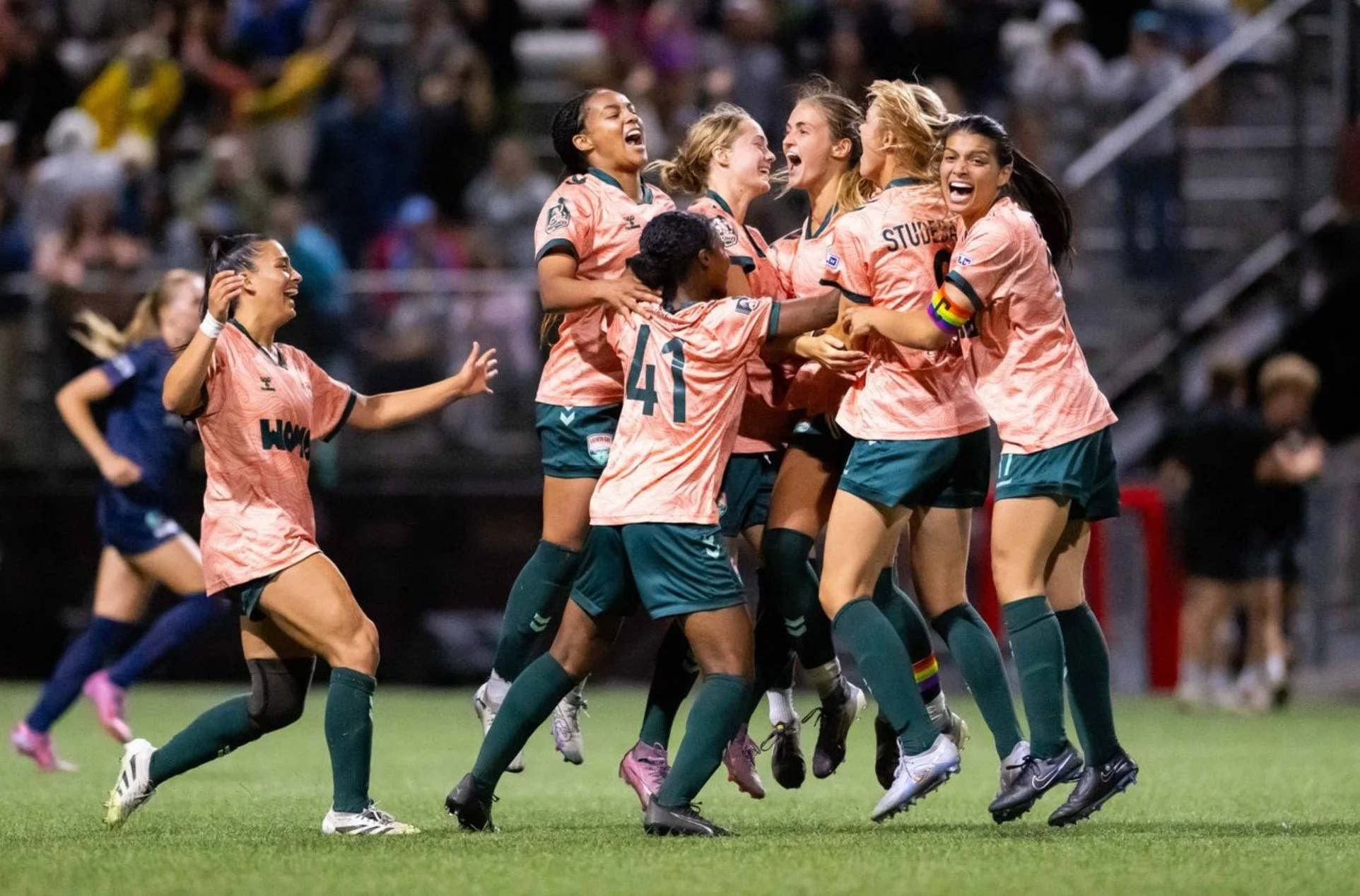
Seattle’s Salmon Bay FC win their league in their inaugural season; there’s something deeply rewarding about supporting the community leagues
Reflecting on the Inertia of a New Season
It’s at this point that I have to admit a fundamental truth. I need to be honest with you reader, and myself.
As another NFL and Premier League season draws near, I feel my anticipation growing again. That’s the thing about inertia, there was a force exerted at one point in time to set the whole thing in motion. In my case, I know the excitement is largely driven by a combination of nostalgia and novelty: hearing Peter Drury’s voice as he narrates the next great clash between English clubs, the drama of watching a last minute touchdown or turnover decide two games simultaneously on RedZone, even just the quiet but simple thrill of tradition, coming back to something I deeply love that I’ve missed for many months.
Richer Than God was an important book for me, however. I’d also be lying if I pretended that it was simply “business as usual” regarding how I think about my sports consumption and what I want out of a relationship with the teams I support. And in truth, it has been that way for a while. A long time ago, in my early twenties, I certainly enjoyed entire Sunday’s dedicated to watching football and not much else. But that hasn’t been the case for a while; in the last few seasons I’ve found myself going on Sunday afternoon runs to “touch grass” after being cooped up inside, and it’s now more often the case that I have a game on mute in the background while my focus is primarily on a book or game that I’m more passionate about (I’m treating multi-tasking as a sort of progress…).
David Conn is not one to moralize - his book doesn’t chide readers who want to keep watching Premier League football, and indeed, many of Conn’s friends and colleagues are still invested in Manchester City. But the book does implicitly pose the question to its readers about personal agency in the context of sports fandom; what is your relationship to the Sports Industrial Complex?
It's a question I plan to wrestle with more actively this season. Conn's narrative is powerful, and it aligns with a growing sentiment of mine: a skepticism toward how capitalist incentives have altered the operational structures of otherwise worthwhile endeavors. It’s a theme that’s pervasive far beyond the world of sports, as key societal interests have already been captured by moneyed interests. Sports sits in a fascinating position, because in one sense it is purely a domain of leisure, and thus an area that a principled individual should be able to comfortably do without in service of a greater ideal. High ideals aside, getting more time back in my schedule to focus on books in my backlog, or time spent with loved ones and friends, always feels more fulfilling than mindlessly tuning in every week to the same thrills with a new coat of paint.
On the other hand, I’m also intrigued by how to actually institute positive change given the system is what it is. To take a higher stakes example, we can’t sit out democracy simply because corporations have captured democratic institutions and ruined the founding ideals of the whole thing; we have to adapt, be clever, and fight for change. So why wouldn’t I adopt the same attitude towards these games that I hold so deeply, that I think at their best are a positive expression of humanity?
To end on one notable theme, Conn does have positive things to say about Manchester City’s stewardship under its Emirati owners. Though competent ownership is not an overriding factor that will bring him back into the fold of fandom, he notes that “They seemed to be the first owners in my lifetime who really understood what they had, how precious it was to own a football club, and what responsibilities came with it.”
I couldn’t help read this and not think about the Wrexham story in the modern context. I've followed the club closely since celebrities Ryan Reynolds and Rob McElhenney (now Rob Mac) took over during the pandemic; I'm a big fan of McElhenney's show It's Always Sunny in Philadelphia, so I was naturally curious when he announced this new venture.
I've since watched every season of the FX documentary chronicling the club's record-setting run of three straight promotions, and it genuinely seems like the new owners have been a positive force for the community. The tv show is obviously branding for the team, but it’s also filled with human interest stories and it’s hard to argue that the owners have been anything but positive for the team and the supporters.
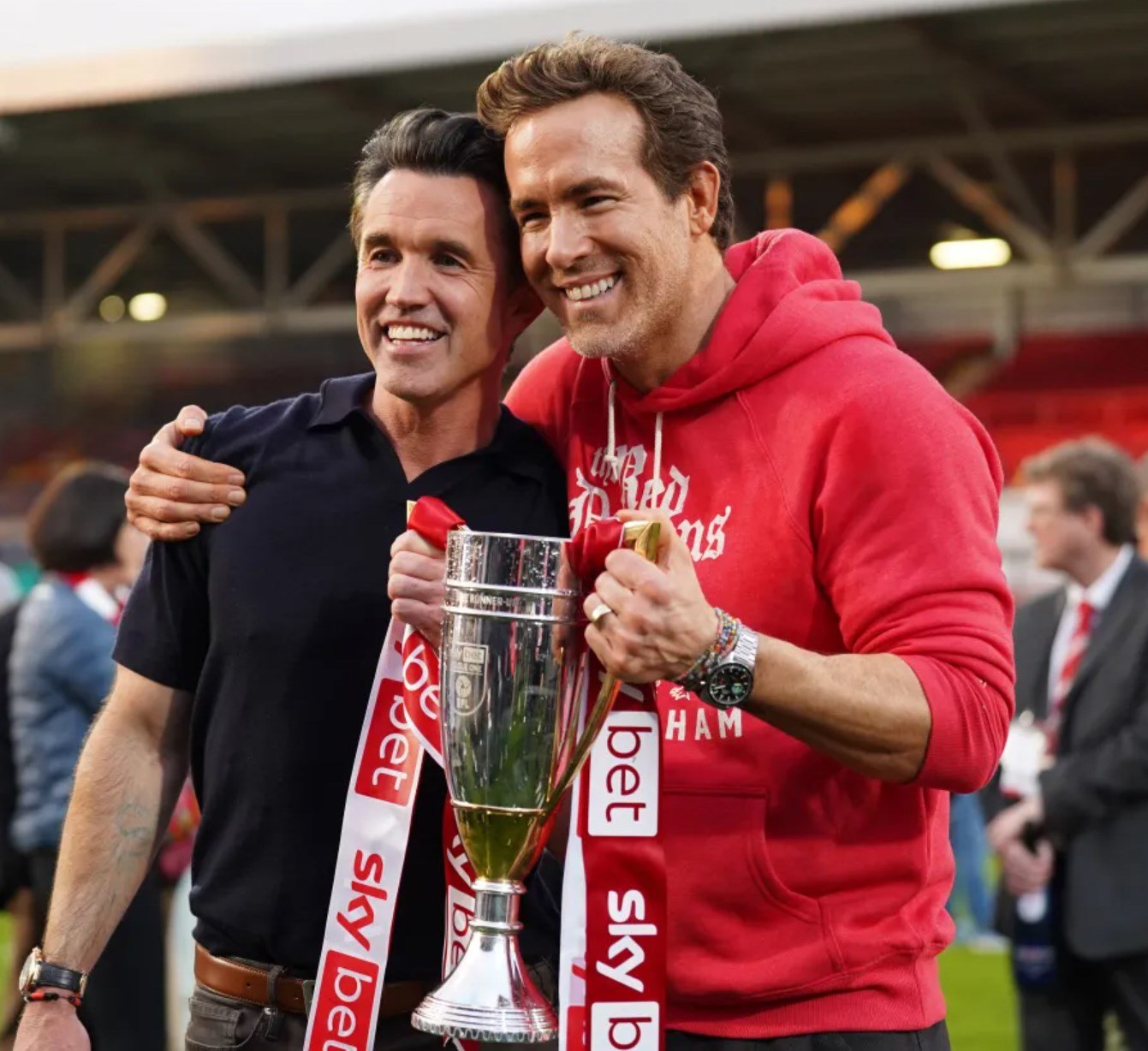
Rob Mac and Ryan Reynolds celebrate promotion as owners of Wrexham FC; the duo have run and promoted Wrexham with a clear attitude towards investing in the community, all while trying (and succeeding) to stay competitive with the reality of modern football
Right now Wrexham are merely one positive story amidst a sea of negativity. They are the exception, not the rule, and it’s still not clear how they’ll be able to keep to their commitments as the team chases larger and larger ambitions. But is it horribly naive to say that I have hope?
Watching the Wrexham story has reminded me that sports is at its best when it’s focused on connecting and empowering its fans. Two American owners have taken over a Welsh team, attracted millions of news fans from around the world, but kept their impact consistently focused on the local community who has the deepest roots to the team. I think what encourages me most is that Rob & Ryan are succeeding in the modern sports ecosystem, but they are doing it in a way that stays fundamentally true to the values it all started with.
Because that’s why we’re in this mess to begin with - too many owners, players, and fans have strayed from the fundamental values of why we’re all doing this in the first place. Today it’s too much about the money and not enough about the love of the game and the community its shared with.
Richer Than God was a welcome challenge to my sports-watching inertia. With this book, Conn was planting a flag in the ground to stay true to his belief that soccer is “the people’s game”, and not intended to be a plaything of business elites. Few Manchester City fans alive today can claim to have the historical pedigree he has going to games as a child and following the team for decades through obscurity and failure before the past decade and a half of overwhelming success.
Ultimately, Conn’s point isn’t to begrudge modern supporters, but to ask a fundamental question: can any stack of trophies, overpriced kits, or priced-out tickets ever replace the raw magic of paying a few quid to watch a club that truly belongs to its people?
Lessons from David Conn
I found Conn's perspective on fandom strikingly similar to my own. Conn lived through an increasingly tacit acceptance of the influence rich owners have on the modern game, but also emphatically felt that very few people fall in love with their team because of a direct link to ownership. As I write this, Vinod Khosla and his investment group have taken over the Seahawks, and fans across the city are anxious to know whether it will have an impact on the team. It’s an anxiety borne from a long history of owners having no vested interest in the team and a lot of vested interest in making money (Khosla will have to give up a minority share in the NFL’s 49’ers, the Seahawks arch enemy).
Conn’s own disillusionment with the perils of ownership’s incentives for making money comes with growing past adolescence and into a career as a journalist. He interviews the club's new chairman, Francis Lee, a former player and local hero, only to find that Lee, though publicly beloved, is privately in it for the money (and not even particularly good at that part). With the advent of cable television and the Premier League, owners began to realize they could take their clubs public and grow very wealthy selling stakes in what had never really been, to Conn or to most football fans, a company. It was a community. A club.
One of the areas of Conn’s growth I found most compelling was his attitude towards soccer as something to play rather than something to watch. Conn is a lifelong player, recalling miserable and muddy fields he played on in Manchester as a boy. He mostly recalls these games with a sentimentality, but they fall well short of his deep love of Manchester City at that age. He freely admits that as a child, he couldn’t imagine enjoying playing soccer more than watching soccer. Decades later, in his self-described older and more tired body, he now enjoys playing far more than watching. It was an inspiring sentiment, and although it’s been years since I’ve laced up my ill-fitting cleats, I seriously want to look at getting involved in a local team here in Seattle to rediscover some of the game’s joy I’ve been missing.
There's also a beautiful section on those who pushed back against money's growing influence in football, particularly at Manchester United, with the formation of FC United of Manchester, and later at AFC Wimbledon. These clubs will likely always be limited in scale, without the resources of the top leagues, but there's something romantic, and genuinely principled, about investing your energy there. I'm lucky to live in Seattle, where we have a strong community of local clubs in Ballard FC and Salmon Bay FC, and the energy around that endeavor feels stronger for it.